Wednesday, July 21, 2010

Where I live and work

As I have mentioned before, I live in an area of San Jose called Cedros. I'm about 20 minutes from Central San Jose by bus, which is pretty much the only way I can get there. I tried to find Cedros on a map, and I failed pretty hard. I did find the neighboring areas, and thought maybe I could mark where I live, but no such luck. It turns out that street names on maps make matters much worse when you are used to navigating by landmarks.

Anyway, I live on the calle ancho 400 m east of the Perimercado (a grocery store). Calle ancho means "wide street" and it is the name given to any street that looks like mine - a very wide T-intersection. I live in an apartment complex with 7 condominios, which each have two bedrooms, a bathroom, small kitchen - all off of the living area. I'm in mine all by myself, now that Amanda has gone home, which is fine, albeit a bit lonely occasionally. So I leave my door open, and Luz comes by almost every night to play UNO with me. We use the game to work on her english skills - what color is the card, what number.

The UBL is two blocks (200 m) east of my apartment. I walk up the main road, and then turn in at the UBL's driveway, which is very steep. The UBL consists of the main building, with offices, classrooms, and the library, the guard house, student dormitories, la casa de miliones (which is also a classroom/meeting space) and the big chapel. The rest of campus is green space, including a spot where many of the students play soccer, and a small meditation garden.

I spend most of my time in the library, which covers about half of the second floor. I have finished several projects already, but my current project is probably the most interesting, and will certainly last me quite some time. I am scanning in images from the "Latin American Evangelist," a magazine begun in the early 1920s which chronicles the missionary work of a wide variety of reformed tradtions in Latin America, under the auspices of the LAEC (Latin American Evangelists Conference(?)). The UBL was begun by the LAEC, though it was originally named the Instituto Biblico, or Bible Institute. It started as a women's school, but quickly began to educate men as well as women. The images I am scanning are all from the Instituto, pictures of teachers, students, and buildings. Alongside these images are the chronicles of the LAEC, which are fascinating. Operating in a very Catholic context, it was very common for priests to threaten violence to the missionaries (envangelistos), and for the converted people to be ostracized in their communities. The LAEC also ran a hosipital - the Hospital Biblico, a childrens' home, and several churches. There was an article written after part of the board of LAEC went to Morocco. The article spent quite a while discussing the evils of the veil, and how it was a shameful thing, and wouldn't the women be better off if they were christian? Up until the last, it could have been taken nearly word for word from an article written today. It has been fascinating to read them as I search for images, and has really brought home the conflict and divide between Catholics and reformed traditions (or as they say here, Catholics and Christians). Wow. Okay, sorry about that history of mission work in Latin America jaunt.  And for the painful grammar of the last bit.  

Monday, July 19, 2010

Mission Group 1: Louisiana

This last week, as I noted in my last post, we've had a mission team from Louisiana here at the UBL. They range in age from 21 to grandparents - my best guess would be about 75. They are all members of a small church in a parish about the size (population-wise) of Grinnell-the-town. The group includes a kindergarten teacher, several retirees, a prision librarian, a hair dresser, and a university student. They spent the first few days they were here painting the chapel, the casa de miliones (de mujeres), a kitchen somewhere, and one of the apartments. They also did some roof repairs here at the apartments, for which I am very grateful!

The team has been very friendly. Though none of them really speak Spanish, they have been very interested in getting to know the students and the children here. I ate lunch with them everyday, and my "payment" was translating the questions and answers of the students Becky invited to eat with them. The people invited varied from professors from the US and Switzerland, to Costa Rican students, to Peruvian political-prisoners-turned-seminarians (which is pretty fitting, when you think about it). I am very grateful for the opportunity I've had while they were here (and will have again with the next group) to learn more about the students. I see most of them in the library, and know their names and where they're from, but I know very little about their lives. I knew J. was from Peru, but I didn't know that J. had been in jail for 9 years, accused of terrorism, though he never received a trial, and once he did, was immediately freed since he was found innocent. I knew that B. was nearly blind, but I didn't realize that B.'s family had supported her through school, despite a degenerative vision problem, and continue to support her dreams of becoming a teacher. It has been a humbling experience.

Speaking English has been a bit of a relief as well, to be honest. I am rapidly regaining language proficiency, but it is still difficult for me, and translating is hardest of all. I am past the point of needing to do a running translation in my head for all but the most difficult parts, but actually translating from Spanish to English is hard - I often have a really good grasp on the ideas being presented but no clue how to turn them into English phrases, and when I do, they come out ridiculously awkward and stilted. Sigh. Oh well. I like pretty much everyone (the guy who asked derisively what there was to do in Minnesota has earned my eternal enmity), and they're all very interesting, lovely people. Plus, in return for translating, I get to eat lunch with them, which is a whole week of not having to cook for myself, which, let me tell you, is awesome.

Thursday, July 15, 2010

Sarapiqui

Chocolate, monkeys, and crocodiles, oh my!
Yesterday, I went on a day trip to Sarapiqui, which is about an hour and a half outside San Jose, through cloud and rain-forest. I went with a group of Methodists from Louisiana who are at the UBL for a mission trip. There are 11 of them, and the youngest is 21, so they're a bit older than I am. We all got up at the crack of dawn (really. when I got up, the sun wasn't up yet) and got in a minibus with our guide for the day. We took the bus up through the mountains, and then down to the lowlands, to a city called Puerto Viejo. We were headed for the Tirimbina Biological Reserve, which hosts a variety of tours as well as a local education program, teaching local kids about the rain-forest to help preserve it. At Tirimbina, we took a "chocolate tour."

We crossed an 800 ft suspension bridge to the small cacao plantation on the reserve. There we learned about the growth of cacao, and also got to watch/participate in the traditional chocolate making process, from opening the cacao fruit to grinding the roasted seeds. And we got to sample the chocolate at all stages, which was pretty sweet - not literally, since most stages are actually really bitter.

We also saw several different types of birds, a strawberry poison frog, and a hog-nosed pit viper. (I thought I could take comfort in the fact that it was tiny - maybe the length of forearm, but then I was informed that the younger -read smaller- the snake, the less control they have over the amount of venom injected. Lesson: the younger the snake, the more dangerous.)

After lunch, we returned to Puerto Viejo, where we got into a boat on the Rio Puerto Viejo to take a river tour. We mostly saw birds, but we did see a troop of howler monkeys, three or four caimans, about a bajillion iguanas in trees, and a crocodile!

The crocodile was massive - the guide thought it was about 10-11 feet long, which is way more crocodile than I ever wanted to see. It was also a really lovely way to spend an afternoon, floating slowly along a river, looking at birds.

We then drove back to San Jose, and had several volcanoes visible for most of the ride. Volcan Turrialba is smoking, and has been for the last few months. No one really knows if that means that it will blow or not; it could just be letting off steam. I also saw Volcan Barva, which I am hoping to take a day trip to climb, because it has some beautiful lakes up top. Anyway, it was a pretty sweet trip, and I'll be headed back to the region at least twice - once to climb Barva, and once to go on a birdwatching tour at La Selva Biological Reserve.

Hart! Ben! I was at your stomping grounds! It was exciting! I thought about both of you all day long!

Saturday, July 3, 2010

Manuel Antonio

This last weekend, Amanda and I took a 4 hour bus ride to the Pacific Coast, to a national Park called Manuel Antonio. The park is famous for its beaches, monkeys, and iguanas. We saw all three, plus some others - two sloths, a deer, raccoons, and a large rodent we never identified. I went a little crazy on the photos, so I'm just posting the best of the bunch. This is a photo of the north end of the main beach in the park, which is where Amanda and I went swimming. On the south end were tons of high schoolers playing volleyball and honeymooning couples making out. Either way, it was more crowded than we were interested in. The water was a nice temperature - cool in comparison to the outside air, but not so cold it gave me the shivers.
The park is, of course, famous for the animals. Here are two examples; I can't tell you how many monkeys and iguanas we saw, not to mention the two sloths, a red and blue crab, hermit crabs, a crazy lizard that looked prehistoric. . . it was pretty great on the animal sightings side of things.
Manuel Antonio is also a really famous tourist area. It was nice to have a break from speaking Spanish, especially since Amanda doesn't speak any, and so I had to translate for her during the weekend as well. Because it is a tourist area, there are tons of hotels. We stayed at The Falls Resort, which was pretty sweet. One of the most exciting things (for me, anyway), was the running hot water (as noted in my last entry). But the hotel was really nice, with cotton sheets, a/c . . . the whole nine yards. Plus, the center of the resort was an  overgrown jungle garden, with birds, lizards, butterflies, R.O.U.S.'s, and monkeys. On our last day there, we saw at least 5 monkeys, two of which were mama monkeys with babies clinging to their backs. Pretty much adorable and a fantastic way to close out our stay. The photo to the left is the view into the garden from our room. Pretty hard to tell its a hotel, yeah? The other great thing about being in a tourist area was the wide variety of restaurants we had to choose from. We decided to eat at El Avion on Saturday night, which is a restaurant built around a plane from the Iran/Contra Affair. Remember that plane that got shot down over Nicaragua? There was a second one ready to go in Costa Rica, but after the US government declared it had nothing to do with the first, the second got left at the San Jose International Airport, since the US gov't couldn't exactly claim it. Several years ago, a business man bought the plane for $3,000 and shipped it to Manuel Antonio. Then he hauled it up the main road, and parked and reassembled it on the edge of a cliff.  The result is pretty spectacular. The plane houses the bar, and underneath the wings there is a large balcony, which is where we ate. This photo is the view from out table out over jungle and the Pacific. Pretty sweet, no? It was pretty great, and the food was really good. It was the only time the whole trip we didn't eat casados, which are a traditional Costa Rican dish. They consist of rice, beans, and some type of meat or chicken, plus veggies or a small salad. I love casados; they're my preferred meal here. Instead, I had pasta with veggies which satisfied the part of me that had been craving vegetables, and Amanda had a hamburger, which satisfied her craving for American food.

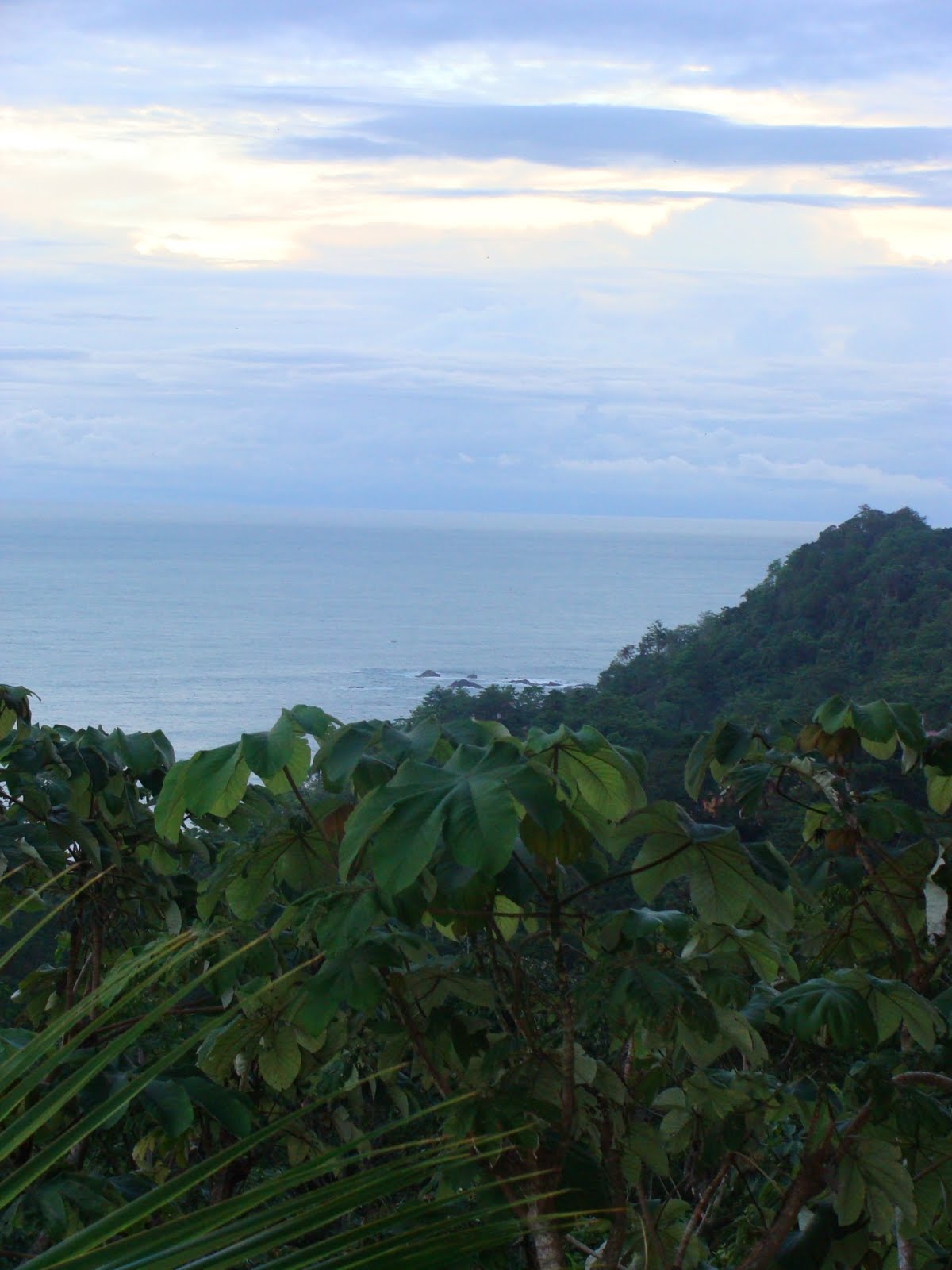
While in the Park, we also did a hike around what I guess could be called headlands, though they're covered in rainforest. The trail is called the Cathedral Trail, and I have no idea why. But it was a lovely, very short, very hot hike. There are a variety of lookout points along the way, some of which overlook the public beach, the ocean, and the park's beaches. While on the trail, we saw our second unidentified ROUS, as well as what we think was a legless lizard, and several iguanas. This is the view from a lookout:
So all in all, it was a pretty fantastic trip. I had a great time, and I think Amanda did as well. We did a lot of hiking, but also plenty of lazing around on the beach, which was rest time well deserved.
This last photo is of me and Amanda at the Park Entrance. Amanda has gone back to the States, but it was super great to have her here for a bit, and to have a traveling companion!

Monday, June 28, 2010

Creature Comforts

One of the things living in Costa Rica is teaching me is how many things I take for granted. One of those things: hot running water. I do have an electric-water-heater-shower-head so I get warmish showers, but everything else I do is done with cold water. And hey, I'm not complaining. I can drink the water here. There's enough of it to go round (mostly - the first weekend I was here, there was a planned water-outage for 24 hours) and in most places in the country, its clean water. I am more aware of my water usage here - I take fewer showers, and am a lot better about shutting water off for the brief moments in between kitchen tasks. I hadn't even really noticed not having hot water come out of the taps, until this weekend.

Due to their concerns about our safety, Amanda's parents put us up in a really nice hotel/resort on Saturday night. We walked into our hotel room and immediately decided that we would share the bed, since neither of us wanted to sleep on the pull out couch when a bed that looked that lovely was available (it was very lovely). We explored every inch of the room, but our favorite discovery happened while I was washing my hands. I turned the water on, and after soaping my hands, stuck them under the water, and yelped. The water was too hot for my hands. I hadn't even known how much I had missed being able to wash my hands with hot water until I was able to again. And oh my gosh. A hot water heater for a shower is so much better than the electric-shower-head - there was water pressure and the water was uniformly hot.

I've always known that I am privileged - I live a very comfortable life. My worries tend to be more of what my friends and I term "first-world problems": problems that are not about survival but comfort. Missing hot water? I have running water. Who on earth am I to complain? My privileges came out of nowhere and whacked me on the head with a 2x4, and made me much more aware of the little things that I take for granted that are pretty darn great. My bed. Electricity. Internet. A fridge. Washing machine. . . the list goes on and on. And maybe, instead of thinking about the things I don't have, or would like to have, like hot water or a clothes dryer, I should focus on the other lists, of things I do have. 

Friday, June 25, 2010

Cartago and the Jardin Botanico Lankester

So yesterday, instead of going to work in the library, Amanda and I went to Cartago, which is a city about 30 minutes outside San Jose. Cartago was the capital at one point, but being 20 km from an active volcano is not so great - they occasionally get massive ash cloud-plume-things (like that one in Iceland), and more regularly, earthquakes. A while back, there was a massive one that pretty much leveled the city, and then another one. And another one. At which point, the ticans decided to move the capital. Now the Cartago's claim to fame is the Basilica, which is not so interesting from the outside, but really, really beautiful on the inside. The Basilica de la Virgen de los Angeles (the patron virgin of Costa Rica) is home to La Negrita, or The Black Virgin.
 
Story-time:A young indigenous girl was gathering firewood and found a black, rock statue of the virgin sitting on a rock. She took it home with her, and put it in a box with her other keep-sakes. The next day, she happened by the rock again, and saw another statue sitting on it. She thought it would be fun to have two dolls, so she brought it home with her. But when she opened up her box, the first doll was gone. Assuming someone had stolen it, she put the second doll in the box, and locked it up. When she opened it in the morning, the doll was gone, and once again, could be found on the rock. The same thing happened to the Priest, when the girl showed the doll to him. So, they built a chapel there. The Virgin, if moved, would always reappear there, until too many earthquakes had come (she survived them all), and she decided it wouldn't be the end of the world to be encased in gold and jewels and sit in a Basilica instead. The END.

So. Amanda and I arrived in Cartago, and walked to the Basilica. On the way there, we passed Las Ruinas, which are the ruins of some big church. They are really lovely, and the inner part is planted with a nice garden.
 We continued walking to the Basilica, and slipped inside, where we saw La Negrita, and the Holy Water that's there, as well as the ofertas made in honor and thanksgiving to La Negrita. The Basilica is the Catholic pilgrimage site in Costa Rica, and I am hoping to go back for the Feast Day, on August 2nd. People crawl for kilometers on their way to the Basilica. When it isn't August 2nd, people enter the church, and get down on their knees to crawl to the altar. It is amazing, and completely different from anything I am familiar with in the church.

The ofertas are all gifts made to La Negrita, and they run the gamut from small milagros (silver/pewter charms) to trophies to what looks like heirloom jewlery. Some of the more spectacular ofertas are on display underneath the Basilica - there were a number of replica airplanes, several really beautiful rings, a large clay vase, a medal of honor from the US Airforce. . . and most of them are accompanied by small notes explaining why the offering was made.

From the Basilica, we walked to a bus stop, and got on a bus to Paraiso, which took us to the Lankester Botanical Gardens. We had been told by Ruth (an American professor at the UBL) that we should go, and though skeptical, we decided we might as well make the trip. The gardens were amazing. They have one of the largest orchid collections in the country, and while orchids are not currently in bloom, there were a few that were blooming.

There is a Japanese Garden, which was donated by the Japanese Government to the Universidad de Costa Rica, and it was incredible.

There were also examples of the different types of Costa Rican plants, and forests. In one of them, we saw a butterfly with wings as big as my palms, if not bigger. We also saw a nest with a baby bird inside. We wished we had packed a picnic lunch, but hunger drove us back to Cartago, where we ate, and then hopped on a bus back to San Jose.

Once we arrived back in down town, we trekked to the Coca-cola bus terminal where we bought tickets for our trip this weekend to Manuel Antonio, a national park on the Pacific. It was a bit longer of a walk than expected, but we did manage to buy our tickets. By the time we got home, we were dead on our feet, but it was a great day. Tomorrow morning we leave at about 7:15 to take a bus to downtown to catch our next bus, which will take us to Manuel Antonio. I'm pretty pumped about the trip!

Hasta la proxima vez, ciao!

Wednesday, June 23, 2010

a brief and terrified interlude

Don't panic. Me and my adrenaline are doing just fine. In fact, I had a test this afternoon to test my adrenal responses. They work well.

Lightening struck the electrical wires I was walking under on my way home from work. Followed immediately by the loudest thunder I have ever heard.

20 minutes later, my heart is finally not racing.

In other news, its the rainy season here in Costa Rica, and if it doesn't start raining before 2pm, we're pretty much guaranteed a pretty fantastic storm.